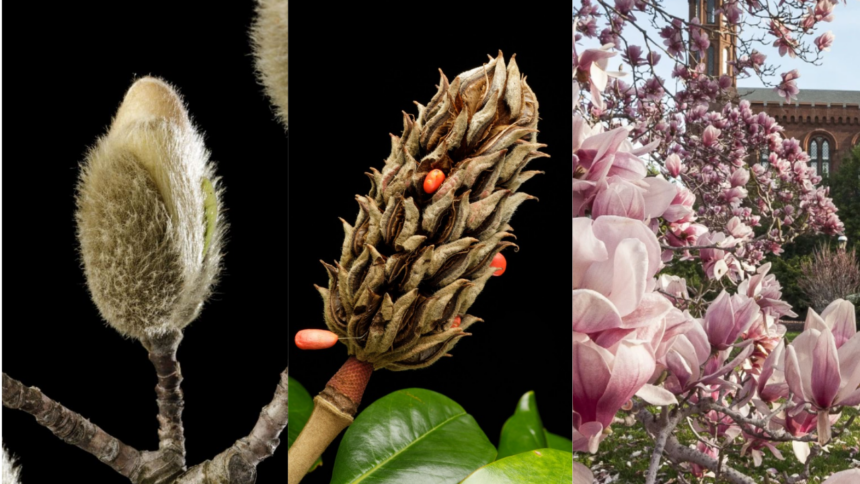
Hidden deep within the lush canopies of modern magnolia trees, scientists have unearthed a piece of evolutionary history that has captivated botanists and naturalists alike. The majestic flowers of these trees have long been admired for their size and fragrance, but it’s the secrets they hold about the ancient plant kingdom that have sparked a newfound sense of wonder. A remarkable discovery has revealed that these 95-million-year-old flowers were not only blooming long before the emergence of bees, butterflies, and many modern flowering plants, but they still manage to attract beetles, defying the conventional wisdom that pollination by insects is a relatively recent development in the plant kingdom.
Unraveling the Mysteries of Ancient Pollination
Researchers have been studying the fossilized remains of magnolia flowers, which date back to the Cretaceous period, to gain insights into the evolution of pollination. The findings suggest that magnolias were able to adapt and thrive in a world without bees, relying on other pollinators such as beetles to transfer pollen. This challenges the long-held assumption that the co-evolution of flowers and insects was a key driver of plant diversification. Instead, the data suggests that plants were able to evolve and diversify independently of insect pollination, with magnolias being a prime example of this phenomenon.
The study also highlights the importance of beetles as pollinators, a role they have played in plant reproduction for millions of years. Beetles are often overlooked as pollinators, but they are capable of transferring pollen between flowers with great efficiency, making them a vital component of the plant-pollinator network. In the case of magnolias, the flowers’ large size and fragrance likely attract a range of beetle species, which play a crucial role in transferring pollen and facilitating the reproduction of these ancient plants.
Unlocking the Secrets of Ancient Plant Kingdoms
The discovery has significant implications for our understanding of the evolution of plant life on Earth. It suggests that the plant kingdom has been more resilient and adaptable than previously thought, with many species able to thrive in a world without the pollinators we take for granted today. The study also highlights the importance of studying fossilized remains to gain insights into the evolution of plant life, a field of research that has been largely overlooked in recent years.
The research team’s findings have sparked a renewed interest in the study of ancient plant life, with many scientists calling for a greater focus on the evolution of plant-pollinator relationships. As we continue to explore the natural world, it’s clear that there is still much to learn about the intricate relationships between plants, insects, and other organisms that have shaped the course of evolution on our planet.
Preserving the Legacy of Ancient Magnolias
As we gaze upon the majestic flowers of modern magnolia trees, we are reminded of the incredible story of how these plants have thrived for millions of years. The discovery of their ancient pollination strategies has sparked a sense of awe and wonder, inspiring us to continue exploring the natural world and uncovering its secrets. By preserving the legacy of these ancient plants, we can gain a deeper appreciation for the incredible diversity of life on Earth and the complex relationships that have shaped its evolution.
The story of the ancient magnolias is a testament to the power of adaptation and resilience in the plant kingdom, a reminder that even in the face of adversity, life can find a way to thrive. As we look to the future, it’s clear that there is still much to learn from the natural world, and the discovery of these ancient pollination strategies has opened up new avenues of research and exploration that will continue to captivate scientists and naturalists for generations to come.