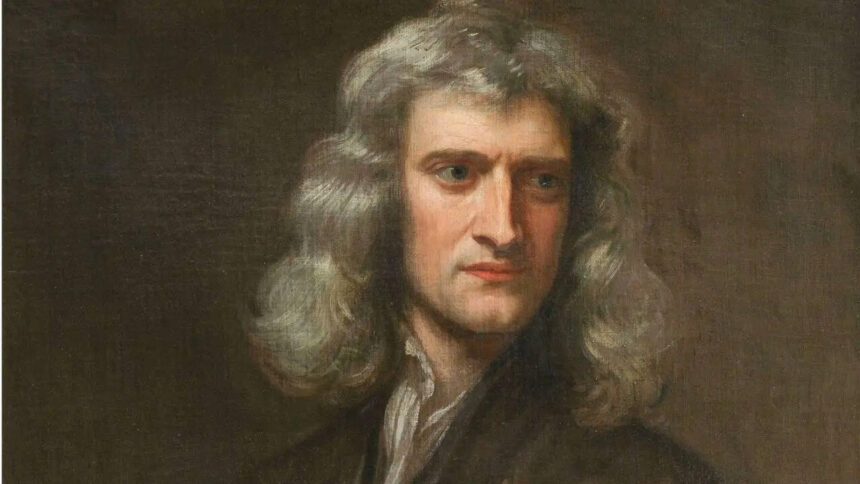
The universe, as Sir Isaac Newton so aptly put it, is a vast, intricate machine governed by precise, predictable laws. His groundbreaking work in mathematics and physics revealed the underlying patterns that govern the motion of celestial bodies, allowing us to chart the trajectory of planets and stars with remarkable accuracy. But despite his unparalleled success in deciphering the workings of the cosmos, Newton found himself befuddled by the human experience. In a candid admission, he confessed that while he could calculate the motion of heavenly bodies with ease, the madness of people remained an enigma he could not crack.
The Limits of Logic and Reason
The contrast between the predictability of the universe and the unpredictability of human behaviour is stark. While we can accurately forecast the orbits of planets and the behaviour of subatomic particles, our understanding of human decision-making and behaviour remains woefully incomplete. This is not to say that we have abandoned all hope of making sense of human behaviour. Rather, it reflects the complexity and depth of the human experience, which defies reduction to simple, deterministic laws.
One of the primary challenges in predicting human behaviour is the role of emotions and intuition. Unlike the universe, which operates according to strict causality, human decision-making is often influenced by subtle, unconscious factors that defy logical analysis. This is why even the most sophisticated models of human behaviour can fall short, as they struggle to account for the messy, contextual factors that shape individual choices.
The Interplay of Culture and Environment
The cultural and environmental contexts in which humans live also play a significant role in shaping their behaviour. From the social norms and expectations that govern individual interactions to the broader cultural narratives that influence our perceptions of the world, the external forces that shape human behaviour are legion. This is why predicting human behaviour across different cultures and contexts is a far greater challenge than charting the motion of celestial bodies.
Consider, for example, the vastly different attitudes towards risk and uncertainty in different cultures. While some societies value prudence and caution, others celebrate boldness and risk-taking. This fundamental difference in cultural values can have a profound impact on individual behaviour, making it much harder to predict than the predictable orbits of planets.
The Limits of Science and the Beauty of Complexity
So what does this mean for our understanding of human behaviour? Does the fact that we cannot predict people with the same level of accuracy as the stars mean that we should give up on trying? Absolutely not. Instead, it highlights the limits of science and the beauty of complexity. By acknowledging the intricacies of human behaviour and the multiple factors that shape our choices, we can develop a more nuanced and empathetic understanding of the world around us.
As Newton so eloquently put it, the universe is a vast, intricate machine governed by precise laws. But human behaviour, by contrast, is a rich tapestry of complexities, contradictions, and mysteries waiting to be unravelled. By embracing this complexity and working to understand the many factors that shape human behaviour, we can develop a more profound appreciation for the human experience and the intricate web of relationships that bind us together.